RWA Tokenization in 2026: Key Data Points and the Research Questions They Raise

By Yulia Leshchenko, Founder and Research Director, IRAIET
The data on real-world asset tokenization in 2026 is no longer speculative. It is measurable — and it raises research questions that the legal and regulatory community has not yet fully addressed.
What the current data shows:
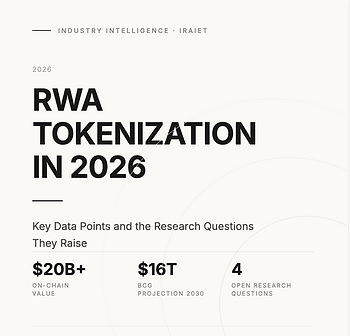
According to RWA.xyz market data and the World Economic Forum's Digital Assets report, the total value of tokenized real-world assets on public blockchains exceeded $20 billion in early 2026, with private credit, US Treasury instruments, and real estate representing the three largest asset categories.
BlackRock's BUIDL fund — a tokenized money market fund launched in 2024 — reached $500 million in assets under management within weeks of launch, signaling institutional validation of the tokenization model at scale.
The Boston Consulting Group projects that tokenized illiquid assets alone could represent a $16 trillion opportunity by 2030.
The research questions these numbers generate:
The growth is documented. The legal infrastructure supporting it is not keeping pace.
→ Ownership recognition across jurisdictions. When a tokenized real estate asset is held by investors in twelve countries, which legal system governs ownership transfer disputes? When a smart contract automatically executes a transfer based on pre-programmed conditions, and that execution is disputed in a jurisdiction whose contract law was not written with automated execution in mind — which law applies, and which courts have standing to adjudicate?
Current international private law frameworks offer inconsistent answers. The Hague Principles on Choice of Law in International Commercial Contracts provide some guidance, but were not designed for blockchain-based instruments. The legal treatment of tokenized securities under the GENIUS Act and CLARITY Act frameworks addresses US domestic classification — it does not resolve cross-border ownership recognition.
This is an active and urgent research question. The market is already ahead of the law on this point, and the disputes that will eventually require resolution are accumulating.
→ IP rights within tokenized systems. When intellectual property — a patent portfolio, a registered trademark, a body of creative work — is tokenized as a real-world asset, what happens to the underlying IP rights structure? Does tokenization affect the enforceability of those rights? Does fractional ownership of a tokenized IP asset create new co-ownership relationships with legal consequences the original rights holders did not intend?
This is almost entirely unresearched territory. The USPTO and Copyright Office's joint study on NFTs addressed some dimensions of this question for digital creative works — establishing that NFT buyers receive legal title to the token and a license to the associated digital asset, not automatic ownership of the underlying IP. But that analysis addressed relatively simple NFT structures. Tokenized IP portfolios — particularly in the context of patent licensing, trademark-backed brand assets, and AI-generated creative works — present a significantly more complex set of legal questions.
The intersection of IP law and tokenization is one of IRAIET's primary research priorities precisely because it sits at the boundary of two legal frameworks that were not designed to interact, and because the commercial stakes of getting the analysis wrong are substantial.
→ Enforcement mechanisms. Smart contracts execute automatically based on pre-programmed conditions. Legal enforcement does not. When a tokenized asset transfer is completed on-chain but the underlying off-chain legal conditions for that transfer were not met — whether due to regulatory requirements, contractual obligations, or third-party rights — the gap between what the blockchain records and what the law recognizes can be significant.
This enforcement gap is not theoretical. It is already surfacing in early disputes over tokenized securities and digital asset transfers where the on-chain record and the off-chain legal reality diverge. The research questions it generates are both doctrinal — what legal frameworks should govern when on-chain execution conflicts with off-chain legal requirements — and practical: how should transaction documentation, legal structuring, and smart contract design be integrated to minimize this gap.
→ Regulatory arbitrage risk. Different jurisdictions are developing tokenization frameworks at different speeds and with different assumptions. The UAE, Singapore, and Hong Kong have moved aggressively to establish regulatory sandboxes and permissive frameworks designed to attract tokenization activity. The EU is developing its framework through MiCA and related instruments. The US is in the middle of a legislative process that may produce comprehensive clarity — or may produce further fragmentation depending on how the CLARITY Act and related legislation advances.
The research questions around regulatory arbitrage in this environment are substantial. How do institutional actors allocate tokenization activity across jurisdictions based on regulatory treatment? What are the systemic risks of a tokenization market that migrates toward permissive jurisdictions to avoid more rigorous oversight? How should international coordination mechanisms be designed to address these risks without suppressing legitimate innovation?
These are questions that require independent, non-commercial research to answer credibly. Industry participants have strong incentives to favor frameworks that minimize regulatory burden. Regulators have limited resources and often insufficient technical expertise to develop frameworks without external input. Independent research organizations exist precisely to fill this gap. What this means for founders and practitioners building in this space
The data on RWA tokenization is unambiguous: this is a market in accelerating institutional adoption, with legislative frameworks beginning to provide the clarity that institutional capital requires. For founders and practitioners building in this space, the practical implications are straightforward.
The legal infrastructure for tokenized assets is still being built — which means the decisions made now about IP structuring, cross-border legal frameworks, and smart contract architecture will either create durable protection or generate disputes that are expensive to resolve. The window to structure correctly is before the legal frameworks calcify, not after.
At IRAIET, we track the research questions that the market's growth is generating — because the quality of the legal frameworks that will eventually govern this market depends on the quality of the independent analysis that informs them.


Comments